

Croatia’s Adriatic coastline is scattered with over a thousand islands, but only a handful carry the weight of civilizations past. From ancient Greek colonies to Venetian trading posts and Benedictine monasteries clinging to rocky shores, these islands have witnessed empires rise and fall while preserving remarkable architectural and cultural treasures.
Each offers a different window into Mediterranean history, whether through Roman villa ruins, medieval fortifications, or traditions that have survived centuries. Here is a list of 15 historic islands in Croatia that reward curious travelers with layers of fascinating heritage.
Hvar

The island of Hvar has been inhabited for at least 3,000 years, with Greek colonists establishing the settlement of Pharos in 385 BC. The Stari Grad Plain remains one of the best-preserved examples of ancient Greek land division in the entire Mediterranean, earning it UNESCO World Heritage status in 2008.
Stone walls, olive groves, and vineyards still follow the original geometrical plots laid out by those early settlers, making it a living museum of agricultural history.
Korčula

Ancient Greeks knew this densely forested island as Korkyra Melaina, meaning ‘Black Corcyra,’ and established a colony here in the 4th century BC. The walled old town of Korčula is often described as a miniature Dubrovnik, with its herringbone street pattern designed to block strong winds while allowing summer breezes through.
The island also boasts one of the oldest civic statutes in Europe, dating from 1214, and maintains a tradition called the Moreška sword dance that has been performed since the 15th century.
Brač

The Greeks called this island Elaphousa, likely meaning ‘deer island,’ though today it’s better known for its brilliant white stone. Brač limestone was quarried for Diocletian’s Palace in Split, the White House in Washington, and countless Venetian buildings.
The island’s highest point, Vidova Gora, stands as the tallest peak of any Croatian island at nearly 2,600 feet, while the abandoned hermitage at Blaca offers a glimpse into monastic life that continued until the mid-20th century.
Krk

Archaeological evidence suggests Krk has been inhabited for up to 15,000 years, making it one of the longest continuously settled islands in the Adriatic. The powerful Frankopan family ruled from here for nearly 900 years, leaving behind an impressive castle in Krk town that still dominates the waterfront.
The island also holds the Baška Tablet, an 11th-century stone inscription considered one of the oldest surviving examples of the Croatian Glagolitic script.
Rab

First mentioned around 360 BC by Liburnian settlers who called it Arba, this island developed into an important Roman and Byzantine settlement. Rab town is instantly recognizable by its four Romanesque bell towers rising above the medieval walls like stone sentinels.
The island hosts one of only two surviving medieval crossbow tournaments in the world, a tradition revived from the 15th century when locals famously defended their town against Norman invaders.
Vis

As the furthest inhabited Croatian island from the mainland, Vis remained a Yugoslav military base until 1989, which accidentally preserved its ancient character. Greek colonists from Syracuse founded Issa here in the 4th century BC, establishing what became one of the most powerful Greek settlements in the Adriatic.
Remains of Roman baths, Greek ceramics, and amphorae from ancient shipwrecks can still be found in the island’s archaeological museum, while abandoned military tunnels add a more recent layer of history.
Lokrum

Just a 10-minute boat ride from Dubrovnik, this small island holds centuries of legend and layered history. Benedictine monks founded their monastery here in 1023, making it the first of many such establishments in the Republic of Ragusa.
When forced to leave in the late 18th century, the monks allegedly cursed any future private owner of the island, and believers point to the tragic fates of subsequent owners like Archduke Maximilian of Habsburg as evidence of this curse at work.
Mljet

Ancient Greeks may have known Mljet as Ogygia, the mythical island where the nymph Calypso held Odysseus captive for seven years, according to Homer’s Odyssey. The Benedictines arrived in 1151, building a monastery on a tiny islet within the island’s great saltwater lake that remains one of the most photographed sites in Croatia.
Roman ruins at Polače and a cave on the southern shore linked to the Odysseus legend add to the sense that myths and history blur together here.
Brijuni

This archipelago off the Istrian coast contains evidence of 3,000 years of human habitation, including over 200 dinosaur footprints preserved in coastal rocks. Roman nobles built luxurious villas here in the 1st century, and the Knights Templar constructed St. Mary’s Church in the 13th century.
More recently, Yugoslav President Tito transformed the islands into his private retreat, hosting nearly 100 heads of state and celebrities from Elizabeth Taylor to Sophia Loren.
Cres

Tied with Krk as Croatia’s largest island, Cres has been inhabited since the Stone Age, with settlements like Beli boasting 4,000 years of continuous occupation. The Romans dug a canal through the narrow isthmus at Osor, separating what was once a single landmass into the islands of Cres and Lošinj.
Osor itself was a thriving trading port on the ancient Amber Route, and you can still walk across the only fully preserved Roman bridge on the eastern Adriatic coast in the town of Cres.
Trogir
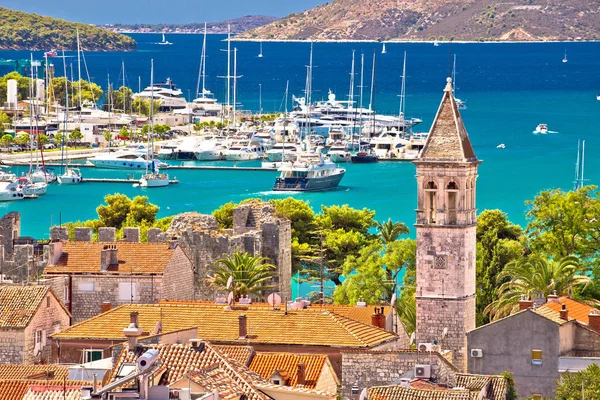
Technically a tiny island wedged between the mainland and the larger island of Čiovo, Trogir earned UNESCO World Heritage status in 1997 for its remarkable urban continuity. Greek colonists from Vis founded Tragurion here in the 3rd century BC, and the original Hellenistic street grid remains visible today beneath layers of Roman, Byzantine, and Venetian architecture.
The Cathedral of St. Lawrence, with its stunning Radovan portal carved in 1240, represents one of the finest examples of Romanesque-Gothic architecture in Central Europe.
Šipan

The largest of the Elaphiti Islands flourished during the Republic of Ragusa when wealthy Dubrovnik families built over 40 summer residences here. Renaissance palaces like the Skočibuha family fortress still stand in the village of Suđurađ, complete with watchtowers built to defend against frequent pirate raids.
The island holds a Guinness World Record for the highest density of olive trees per capita, a legacy of centuries of cultivation, while its 34 churches include chapels dating back to the 11th century.
Pag

The moonlike landscape of Pag, scarred by karst rocks and swept by the bora wind, has supported salt production since Roman times. Pag town was actually relocated in the 15th century after the original settlement was abandoned, and the new town was designed by the famous Croatian architect Juraj Dalmatinac.
The island is also home to a centuries-old lace-making tradition that earned UNESCO Intangible Cultural Heritage recognition, with local women still creating intricate patterns using techniques passed down through generations.
Lošinj

Once connected to Cres before the Romans carved a canal between them, Lošinj became a maritime powerhouse in the 18th and 19th centuries. The town of Mali Lošinj grew into one of the largest ship-owning centers in the Adriatic, and elaborate captain’s mansions from that prosperous era line the harbor.
The mild climate, influenced by surrounding pine forests, turned the island into a fashionable health resort during the Austro-Hungarian period, when wealthy visitors came to breathe the therapeutic sea air.
Lastovo

Isolated and largely overlooked by mainstream tourism, Lastovo has been inhabited since prehistoric Illyrian times and later became an important part of the Republic of Ragusa. The island’s main town features an unusual amphitheater-like arrangement of stone houses climbing the hillside, their chimneys decorated in distinctive Ottoman-influenced styles unlike anything else in Croatia.
During Carnival, locals celebrate the Poklad festival, a tradition dating back centuries that commemorates a medieval victory over Catalan pirates.
Where Ancient Shores Meet Modern Discovery

Marked by Greeks, then Romans, later Venetians, Croatia’s islands bear quiet marks of many hands across ages. Not preserved behind glass, they breathe with daily life — fishermen pull nets where merchants once docked ships.
Ancient olive groves, rooted long before modern borders, yield oil season after season. UNESCO sites stand beside hidden coves where tales of Odysseus may have taken shape in whispers. Walking these shores means following steps worn deep by those who came hundreds of years before. To be here is less like observing history — it becomes the ground beneath your feet.
More From Travel Pug

- Underrated Italian Towns That Beat the Tourist Crowds
- Las Vegas Tourist Traps to Skip
- Prettiest Towns in Every US State
- 18 passport-free countries for Americans
- Signs Your Cruise Is Not Worth The Cost
Like Travel Pug’s content? Follow us on MSN.