

Jordan packs an absurd amount of history into a relatively small country. Ancient civilizations left their mark everywhere — carved cities in rose-red cliffs, Roman ruins that rival anything in Italy, Byzantine mosaics that still dazzle after 1,500 years.
Most travelers hit Petra and maybe one or two other spots before heading out, which means they’re missing castles, amphitheaters, desert fortresses, and sites where biblical events supposedly went down. The country sits at a crossroads where empires collided for thousands of years, and the evidence is scattered across deserts, mountaintops, and valleys.
These fifteen sites represent the best of what Jordan’s got. Here is a list of 15 historic sites in Jordan.
Petra
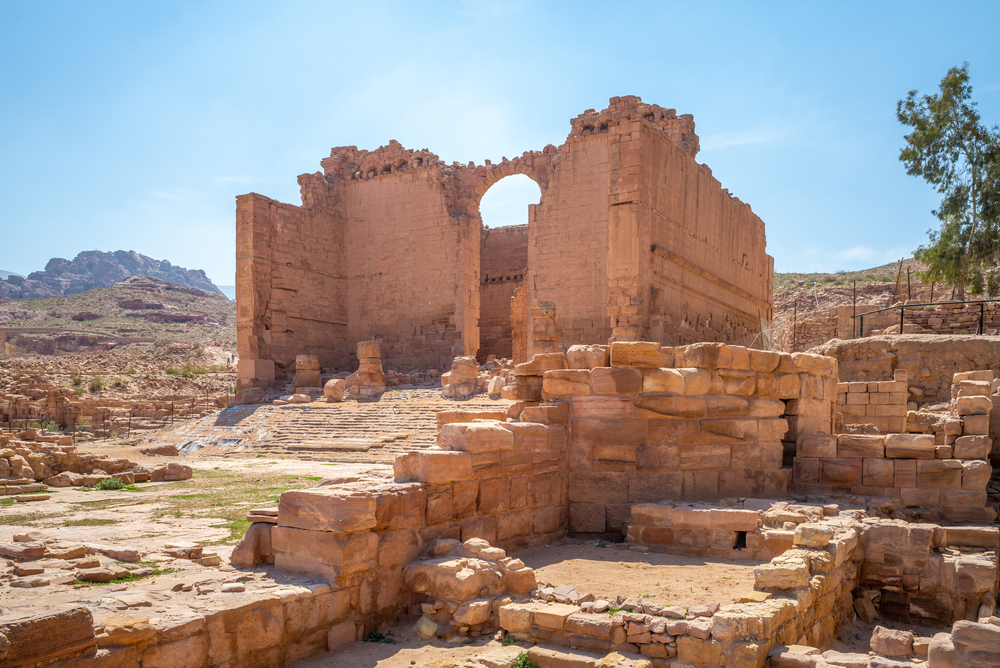
The Treasury appears at the end of the narrow Siq canyon — that first glimpse hits different than photos suggest. Petra was the Nabataean capital from around the 4th century BC, and these desert traders got rich controlling incense routes between Arabia and the Mediterranean.
The rose-red sandstone changes color throughout the day as sunlight shifts, turning everything from pale pink to deep crimson. Beyond the Treasury you’ll find the Street of Facades, an amphitheater carved from solid rock, hundreds of elaborate tombs, and the Monastery sitting at the top of a steep climb.
The site sprawls across valleys and cliffs — you could spend three days here and still not see everything.
Jerash

This Roman city often gets called the Pompeii of the East, though honestly it might be better preserved than actual Pompeii. The colonnaded streets, temples, theaters, and that distinctive oval plaza survived because earthquakes buried everything, which ironically protected it for centuries.
Hadrian’s Arch marks the entrance, built in 129 AD when the emperor visited — they left the sides unbonded expecting the city to expand and connect walls to it, which never happened. The Temple of Artemis dominates the hilltop with columns that wobble slightly when you push them, creating this eerie humming sound.
Walking down the Cardo Maximus, you can still see chariot wheel marks worn into the stone.
Wadi Rum

Lawrence of Arabia filmed here in 1962 and kicked off Jordan’s entire tourism industry with those desert shots. The Bedouin Zalabieh tribe has lived in this protected area for generations, and they now run most of the camps, tours, and guide services.
Massive sandstone mountains emerge from wide sandy valleys, reaching heights over 5,500 feet, with narrow canyons cutting deep into the rock. Petroglyphs from the Thamudic people date back to 800 BC — over 25,000 inscriptions scattered throughout the desert.
The area earned UNESCO status in 2011, partly because those rock carvings provide crucial insight into how ancient writing and literacy evolved. Sunset turns the red rocks into something almost unreal.
Mount Nebo

Moses supposedly saw the Promised Land from this mountaintop before he died, which makes it one of Christianity’s more significant pilgrimage sites. The Memorial Church sits at around 2,600 feet elevation with views across the Jordan Valley toward Jerusalem — on clear days you can spot the Dead Sea, Jericho, and Bethlehem.
Byzantine mosaics from the 6th century cover the church floors, depicting hunting scenes with zebras, lions, ostriches, and that slightly awkward camel-shaped giraffe. Pope John Paul II visited in 2000 and planted an olive tree for peace, which gave the site a major profile boost.
Franciscans restored everything in 1993 after centuries of abandonment.
Baptism Site

The Jordanian side of the Jordan River, known as Bethany Beyond the Jordan, got recognized by the Vatican as where Jesus was actually baptized. Pope John Paul II’s 2000 visit essentially settled the debate about whether this spot or the Israeli side across the river was legitimate.
Archaeological remains include Roman and Byzantine churches, caves, wells, and baptismal pools from early Christian pilgrims. The site sits about 985 feet below sea level near where the river meets the Dead Sea.
It’s remarkably peaceful considering the spiritual weight — pilgrims can participate in symbolic baptisms at designated areas along the water.
Madaba

This town earned its nickname as the City of Mosaics thanks to dozens of Byzantine-era artworks decorating old churches. The star attraction is that 6th-century mosaic map of the Holy Land on St. George’s Church floor — it originally stretched over 50 feet but only part survived.
What’s left shows Jerusalem, the Dead Sea, Jericho, and about 150 locations labeled in Greek. Fish swim down the Jordan River in the mosaic, with one turning back to avoid the Dead Sea’s poisonous water. The detail is absurd for something made from a million colored stone pieces.
Beyond the map, Madaba has the Archaeological Park with more floor mosaics and the Church of Virgin Mary ruins.
Amman Citadel

This archaeological site sits on one of Amman’s highest hills with views sprawling across the modern city below. Humans have occupied this spot continuously since the Bronze Age around 7000 BC, which makes it one of the world’s oldest inhabited places.
The Temple of Hercules from the 2nd century AD still has massive columns standing, plus you’ll find Umayyad Palace ruins from the 8th century. The Jordan Archaeological Museum on-site displays artifacts from across the country, including some Dead Sea Scrolls.
What works about the Citadel is how it layers civilizations — Ammonite, Roman, Byzantine, and Umayyad structures all jumbled together on one hilltop.
Roman Theater

Downtown Amman’s 6,000-seat amphitheater was built in the 2nd century AD and still gets used for performances today. The stone stairs climb steeply, and acoustics remain sharp — sounds from the stage carry clearly to upper tiers thanks to Roman engineering.
Two small museums occupy spaces within the theater, showing Jordanian folklore exhibits and traditional costumes. The location puts you right in the heart of old Amman with the downtown souks spreading out below.
Climbing to the top tier provides excellent views of both the stage and the city beyond, though the stairs are steep enough to make the climb feel earned.
Umm Qais

Ancient Gadara sits on a high plateau near where Jordan, Syria, and Israel meet, with views across to the Sea of Galilee about seven miles away. The city was part of the Decapolis — ten Roman cities on the empire’s eastern frontier — and thrived as a trade route stopover.
Black basalt and white limestone both appear in the construction, creating striking visual contrast against standard Roman ruins. The West Theatre from the 2nd century AD seated 3,000 people and was carved from that distinctive dark basalt.
An underground Roman mausoleum survived intact beneath a Byzantine basilica and got discovered accidentally when the Jordanian army used it as a field hospital during the 1967 war.
Ajloun Castle

Saladin’s nephew built this hilltop fortress in the 12th century to control local iron mines and counter Crusader threats from the west. The strategic location overlooking valleys gave defenders clear sight lines for miles in every direction.
Islamic architecture dominates throughout — vaulted chambers, arrow slits, stone bridges connecting different sections. It’s considerably less famous than Petra or Jerash but offers that medieval castle experience without tour bus crowds.
The drive up through Ajloun’s green forests feels completely different from Jordan’s desert sites, proving the country’s got more geographical diversity than people expect.
Aqaba Castle

This fortress right on the Red Sea has seen pretty much every empire that passed through the region. Early Islamic construction, Crusader modifications, Mamluk renovations — layers of history stacked on top of each other.
The castle played a role during the Arab Revolt of 1917-18, which most people know from Lawrence of Arabia. Aqaba itself works as a base for diving and Red Sea activities, so the castle provides historical context between beach time.
It’s not the most impressive fortress in Jordan but the location makes it convenient, and the connection to multiple historical periods adds depth.
Desert Castles

These aren’t really castles — they’re early Islamic structures scattered across Jordan’s eastern desert that served as trading posts, caravansaries, and agricultural estates. Qasr Amra has 8th-century frescoes covering the walls and ceiling, showing hunting scenes, musicians, and even a zodiac.
UNESCO listed it because those paintings represent some of the best-preserved early Islamic art. Qasr Kharana looks more fortress-like with its square shape and defensive appearance, though historians think it was actually a meeting place for Umayyad elites.
Azraq Castle is where Lawrence set up headquarters during the Arab Revolt. Visiting them requires a car since they’re spread out, but you can hit several in one day.
Karak Castle

Crusaders built this massive fortress in the 1140s, and it dominates the hilltop town of Karak about 75 miles south of Amman. The castle’s dark stone passages wind through multiple levels with vaulted halls, kitchens, barracks, and those intimidatingly narrow defensive corridors.
Saladin besieged it multiple times before finally capturing it in 1188. What’s impressive is the scale — this thing sprawls across the hilltop with walls thick enough to withstand serious medieval warfare. A small museum inside shows artifacts from Crusader and Islamic periods.
The town itself has character, with markets and restaurants built right into the hillside below the fortress walls.
Shobak Castle

About 20 miles north of Petra sits this earlier Crusader fortress, built in 1115 before Karak. It’s called Montreal in old texts, and the remote mountain location explains why Crusaders picked the spot.
Less restored than Karak, which actually adds to the atmosphere — crumbling towers and overgrown courtyards create that proper ruined castle aesthetic. Tunnels carved into the rock beneath the fortress connected to underground water sources, crucial for surviving sieges.
Saladin captured it in 1189 after a brutal blockade. Far fewer tourists make it out here compared to Petra, so you’ll likely have the ruins mostly to yourself.
Umm Ar-Rasas

This UNESCO site northeast of Madaba contains ruins spanning Roman, Byzantine, and early Islamic periods. The star attraction is floor mosaics from several Byzantine churches, particularly the Church of Saint Stephen with a massive mosaic showing cities of the Holy Land.
A mysterious 45-foot-tall tower stands isolated outside the main ruins — nobody’s entirely sure what it was for, though theories suggest stylite monks used it for solitary prayer. The site feels remote and less polished than major attractions, which means you experience it without crowds or heavy tourist infrastructure. Archaeological work continues uncovering more mosaics and structures.
Looking back, moving forward

Jordan rewards travelers who dig deeper than Petra and the Dead Sea. These historic sites span 5,000 years of continuous human civilization — from Bronze Age settlements to Roman cities, Byzantine churches, Islamic fortresses, and Crusader strongholds.
Each layer tells part of the story about why this particular stretch of land mattered so much to so many different empires. The country’s done solid work preserving and presenting these sites without turning them into theme parks, maintaining that sense of discovery while making them accessible.
Whether you’re into biblical history, Roman engineering, or medieval warfare, Jordan’s got ruins that’ll blow your expectations.
More from Travel Pug

- Underrated Italian Towns That Beat the Tourist Crowds
- Las Vegas Tourist Traps to Skip
- Prettiest Towns in Every US State
- 18 passport-free countries for Americans
- Signs Your Cruise Is Not Worth The Cost
Like Travel Pug’s content? Follow us on MSN.