

Canada sits right next door, shares the world’s longest undefended border with the United States, and speaks mostly the same language.
That proximity creates an assumption among many Americans that crossing into Canada amounts to visiting a slightly politer version of home.
The reality proves more nuanced.
Canada maintains its own distinct identity, shaped by different historical influences, political structures, and cultural priorities that become apparent pretty quickly once someone spends time there.
These differences range from the obvious to the subtle.
Some catch visitors off guard during their first trip north, while others only become clear after spending more time in the country.
They’re not better or worse than what exists south of the border — just different enough to remind travelers they’ve actually left the United States, even if the transition felt seamless at the border crossing.
Here’s what Americans typically discover when they visit Canada.
The metric system is everywhere

Canadians officially adopted the metric system in the 1970s, and they’ve stuck with it.
Speed limits appear in kilometers per hour, not miles.
Gas stations sell fuel by the liter.
Weather forecasts give temperatures in Celsius.
Grocery stores weigh produce in kilograms and grams.
For Americans accustomed to imperial measurements, this requires constant mental conversion or accepting that numbers don’t mean what they usually do.
The shift affects daily activities more than expected.
A highway sign showing 100 km/h doesn’t mean reckless speeding — it’s roughly 62 mph, a reasonable highway speed.
When the weather forecast calls for 25 degrees, that’s beach weather at 77 Fahrenheit, not freezing.
Gas prices look shockingly high until the realization hits that they’re per liter, not per gallon.
After a few days, most visitors develop rough conversion shortcuts, though truly thinking in metric takes longer than a typical vacation allows.
Bagged milk exists (in some provinces)
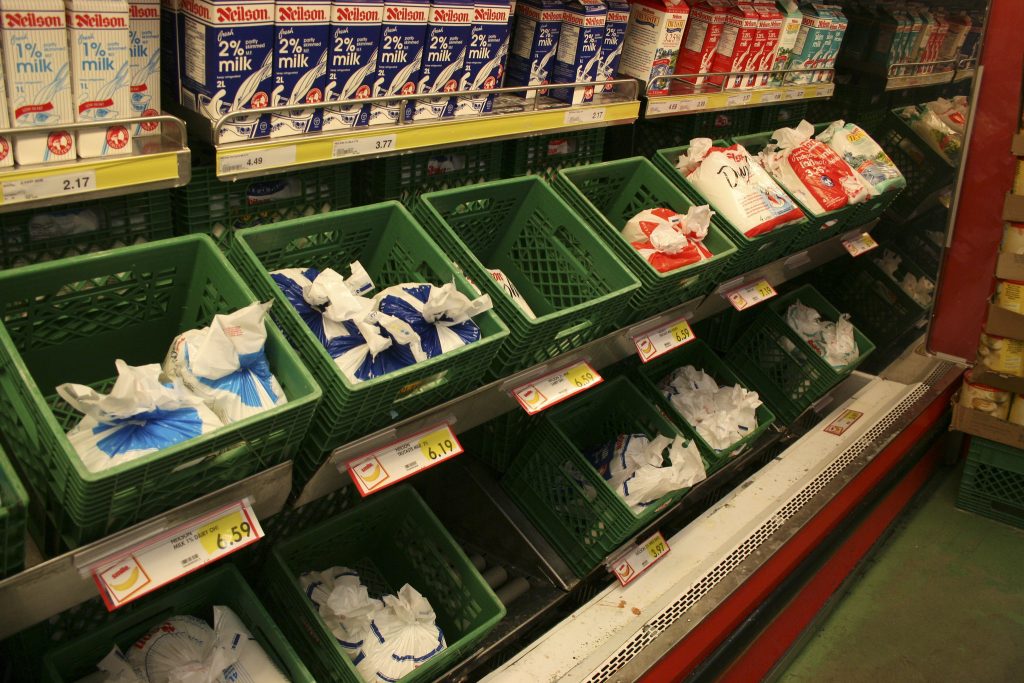
Ontario, Quebec, and the Maritimes sell milk in plastic bags.
Not cartons or jugs — bags.
Three smaller bags come packed inside a larger bag, and households use a special pitcher with a slot where one bag sits.
Snip the corner, pour the milk, and hope the cat doesn’t knock the pitcher over because there’s no lid.
Western provinces like British Columbia and Alberta stick with cartons and jugs, making this an eastern Canadian phenomenon that baffles Americans who encounter it.
The system actually makes practical sense once explained.
Bags take up less space in landfills than rigid containers, cost less to produce and transport, and stay fresh since only one small bag gets opened at a time.
Still, watching someone cut open a bag of milk for the first time registers as deeply weird for Americans raised on gallon jugs.
Some US visitors photograph it like a tourist attraction, which Canadians find amusing since it’s just how milk comes.
The healthcare system works differently

Canada’s universal healthcare system covers medically necessary hospital and physician services for all citizens and permanent residents.
Visitors from the US don’t qualify for this coverage, making travel health insurance essential for Americans heading north.
The system itself operates differently too — no copays at the point of service for Canadians, longer wait times for non-urgent procedures, and a general lack of advertising for hospitals and medical services that blankets American television.
Prescription medications cost significantly less in Canada, even for visitors paying out of pocket.
The government negotiates drug prices nationally, resulting in costs that make Americans accustomed to US pharmaceutical pricing do double-takes at Canadian pharmacy counters.
Some Americans living near the border have historically crossed to fill prescriptions, though regulations and customs enforcement complicate this practice.
The price difference remains stark enough that it’s become a political talking point in U.S. healthcare debates.
French appears on everything

Canada has two official languages — English and French.
Product packaging throughout the country displays both languages, from cereal boxes to shampoo bottles to road signs.
In Quebec, French takes priority and appears more prominently under the province’s language laws.
Montreal operates bilingually in practice, with many residents switching fluidly between languages mid-conversation.
Outside Quebec, French presence varies by region, with New Brunswick being officially bilingual and other provinces having French-speaking communities of different sizes.
Americans often underestimate how seriously Quebec takes French language protection.
Bill 101, Quebec’s Charter of the French Language, requires French to predominate on public signage and in commercial contexts.
English appears smaller on signs, if at all.
Businesses must greet customers in French first.
This isn’t performative — it’s legislated cultural preservation in a province where roughly 85% of residents speak French as their first language.
English works fine in Montreal’s tourist areas, yet making an effort with basic French phrases earns appreciably warmer responses.
Canadians say things differently

Canadian English sounds mostly like American English, yet Canadians have their own vocabulary that can throw off US visitors.
A washroom is a bathroom.
A parkade is a parking garage.
‘Homo milk’ means whole milk (short for homogenized).
A toque is a winter hat.
A double-double is coffee with two creams and two sugars, especially at Tim Hortons.
Dinner sometimes means lunch, while supper means the evening meal, particularly in rural areas and among older generations.
The famous Canadian ‘eh’ actually gets used, though not as frequently or stereotypically as American media suggests.
It functions as a conversational tool to invite agreement or confirmation — ‘Nice day, eh?’ or ‘That’s expensive, eh?’
Canadians also pronounce certain words distinctively.
‘About’ sounds closer to ‘aboot’ to American ears, though Canadians don’t hear it themselves.
‘Sorry’ gets pronounced more like ‘soar-y.’
The word ‘process’ rhymes with ‘progress’ rather than ‘pruh-cess.’
These small differences add up to a recognizably Canadian accent that’s subtle but distinct.
The money looks and works differently

Canadian currency is colorful, waterproof, and made from polymer rather than paper.
Bills come in different sizes depending on denomination, which makes them easier to distinguish quickly.
There’s no one-dollar bill — instead, Canada uses loonies (one-dollar coins with a loon on them) and toonies (two-dollar coins).
Pennies were discontinued in 2013, so cash transactions get rounded to the nearest five cents, though credit and debit charges still show exact amounts.
Exchange rates matter more than Americans expect.
The Canadian dollar typically trades below the US dollar, meaning American money goes further north of the border.
Credit cards work fine throughout Canada, though foreign transaction fees can apply depending on the card.
Prices include different taxes too — provinces charge their own sales tax in addition to or combined with the federal Goods and Services Tax (GST).
Unlike most US states, tax isn’t included in shelf prices, getting added at checkout instead.
That $5 item costs more like $5.65 after tax in Ontario, for instance.
Tipping culture resembles the us but with differences

Canadians tip at restaurants, bars, and for services much like Americans do.
The standard runs around 15–20% for good service.
Tipping practices extend to similar services — hairdressers, taxi drivers, food delivery, hotel housekeeping.
The calculation happens on the pre-tax amount, though some Canadians tip on the post-tax total.
Many payment terminals suggest tip percentages automatically, sometimes calculated on the after-tax amount, which inflates the actual tip given.
One notable difference: Canadian servers earn higher base wages than their American counterparts.
While the US federal minimum wage for tipped employees sits at $2.13 per hour (as of 2025), Canadian provinces set minimums much higher.
Ontario’s server minimum wage is $15.60 per hour, for example.
This doesn’t eliminate tipping culture, yet it does mean servers aren’t as dependent on tips for basic survival.
Some Americans visiting Canada wonder if tips should be lower given higher base wages, but local custom still expects similar percentages as the US.
Canadians take their coffee seriously

Tim Hortons dominates Canadian coffee culture in a way that has no real American equivalent.
It’s not quite as ubiquitous as Starbucks in the US, yet it holds a special place in Canadian identity.
The chain serves coffee, donuts, and increasingly expanded menu items at locations that seem to appear every few blocks in many Canadian cities.
Canadians have strong opinions about Tim Hortons — some swear by it as a national institution, others complain it’s declined since being acquired by Restaurant Brands International.
Beyond Tim Hortons, Canada’s coffee culture runs deep.
Independent cafes thrive in cities across the country.
Vancouver, Toronto, and Montreal have specialty coffee scenes rivaling any American city.
Canadians drink more coffee per capita than Americans, averaging around 3 cups per day according to various surveys.
The country also has different coffee chains — Second Cup, Timothy’s, Blenz — that Americans won’t recognize.
Even McDonald’s coffee has a different reputation in Canada, where it’s generally considered better than south of the border after McDonald’s Canada reformulated its blend.
Winter is a different beast
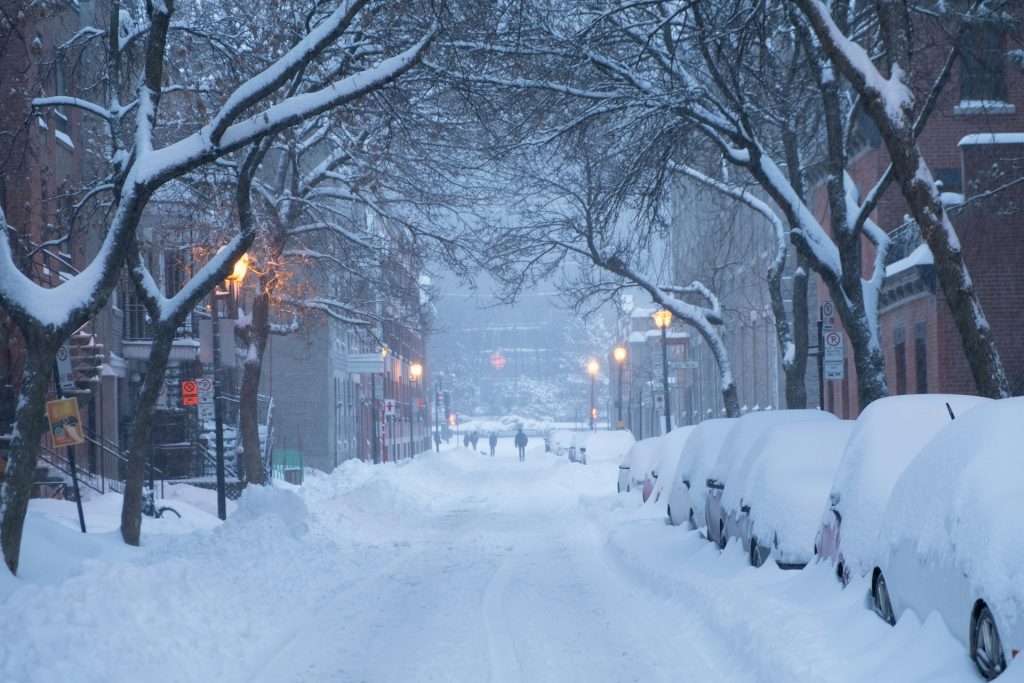
Americans from northern states think they know winter.
Canadian winter operates on another level, particularly in the prairies and inland regions.
Winnipeg regularly hits –40° (where Celsius and Fahrenheit meet).
Toronto gets significant snowfall.
Montreal sees winter lasting from November through March.
Edmonton deals with extreme cold snaps.
The entire country treats winter as a season to endure and adapt to, not hide from.
This shapes Canadian infrastructure and attitudes.
Buildings have vestibules — double-door entryways that create an air barrier.
Underground PATH systems in cities like Toronto and Montreal let people navigate downtown without going outside.
Remote car starters become standard features.
Block heaters for engine oil are common.
Canadians invest in serious winter gear — proper parkas, insulated boots, heavy mitts.
They don’t cancel plans because of snow.
Schools stay open in conditions that would shut down American districts.
Winter tires aren’t just recommended, they’re mandatory in Quebec and common everywhere else.
What sticks after visiting
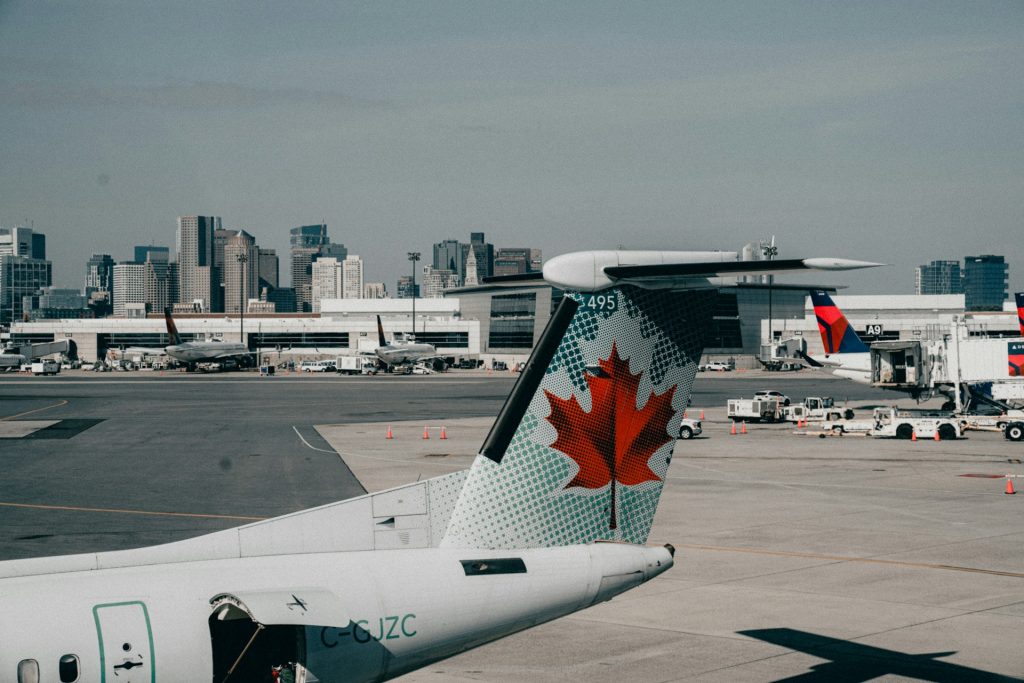
The differences between Canada and the United States lead to a travel experience that is at the same time, familiar and strange.
The main language used is the same (mostly), the culture is interconnected, and the crossing of the border seems to be nothing more than a simple travel procedure.
Still, Canada has been a long time in the making, gradually building its own unique identity as a nation through the politics, the arts, and the past that have all been different from those of the United States.
These differences are easily noticed in the small daily things — buying coffee, checking the weather, getting groceries, chatting with people.
They are not sudden big changes in the culture but rather adjustments.
Canada is neither a smaller version of the USA nor a nation with just one major difference — free healthcare.
It is a separate nation with its own unique lifestyle, and that fact makes the trip more enriching than simply considering it an extension of a road trip to a colder state.
More from Travel Pug

- Underrated Italian Towns That Beat the Tourist Crowds
- Las Vegas Tourist Traps to Skip
- Prettiest Towns in Every US State
- 18 passport-free countries for Americans
- Signs Your Cruise Is Not Worth The Cost
Like Travel Pug’s content? Follow us on MSN.