

The world of museums is undergoing a revolution that most tourists have not yet noticed.
The famous museums such as the Louvre and the Met still attract millions, but a new breed of cultural institutions is redefining what it means to visit a museum.
They are no longer just buildings filled with dusty objects behind glass.
They’re interactive experiences that combine the latest technology and historical artifacts, place communities before collections, and convert passive viewing into active engagement.
Museums are now becoming destinations that structure whole trip itineraries instead of afternoon distractions — from Los Angeles to Lagos, they’re rewriting the rules.
Here is a list of 17 museums that are quietly revolutionizing travel culture.
Each is a different example of how to reimagine what museums can be in the 21st century.
Cairo’s ancient treasures find new home

After more than 20 years of construction and countless delays, the Grand Egyptian Museum opens on November 1, 2025, near the Giza Pyramids.
This $1 billion facility is the world’s largest archaeological museum dedicated to a single civilization.
It will house over 100,000 artifacts across roughly 5.4 million square feet.
King Tutankhamun’s complete treasure collection will be displayed together for the first time since its discovery in 1922 — the iconic golden death mask alongside chariots, jewelry, and nearly 5,400 other items that have never been shown publicly.
Robots teach about themselves
Seoul’s Robot & AI Museum transforms how visitors understand the technology reshaping daily life, yet it does so in a wonderfully meta way.
The orb-shaped building was constructed with help from the very robots it showcases, while drones assisted in mapping the site.
Opening in 2024, this museum engages visitors through workshops where they interact with AI, augmented reality, and virtual reality technologies.
It beats simply reading about them through placards and displays.
Homelessness gets museum recognition

London’s Museum of Homelessness became the world’s first dedicated institution addressing housing insecurity when it opened in 2024.
Run by people with direct experience of homelessness, the museum holds the UK’s national collection on the subject, preserving stories of poverty, displacement, and social action.
Despite this being a sensitive topic, the museum doesn’t shy away from confrontation.
Rather than treating homelessness as a distant social issue, the founders actively campaign for policy changes and conduct independent investigations to fight the crisis they know firsthand.
Storage becomes the exhibition

V&A East Storehouse in London’s Queen Elizabeth Olympic Park flips the traditional museum model by making storage the main attraction.
Opening May 31, 2025, this working store allows visitors to watch conservators and curators handle objects in real time while exploring collections typically hidden in basement vaults.
The approach treats museum operations as equally fascinating as finished exhibitions, demystifying how cultural institutions actually function.
You’d never guess that behind-the-scenes work could be this compelling.
Oman recreates ancient dynasties

The Oman Across Ages Museum near Nizwa uses drones, 3D printing, and augmented reality to transport visitors through civilizations that shaped the country.
Opened recently, the museum deployed drones to map archaeological sites with precision that would have been impossible just a decade ago, then used that data to create digital reconstructions of ancient settlements.
CGI and AR blend seamlessly with physical artifacts.
Visitors can see how historical objects functioned in their original contexts rather than as isolated treasures in glass cases.
DNA inspires Chinese architecture

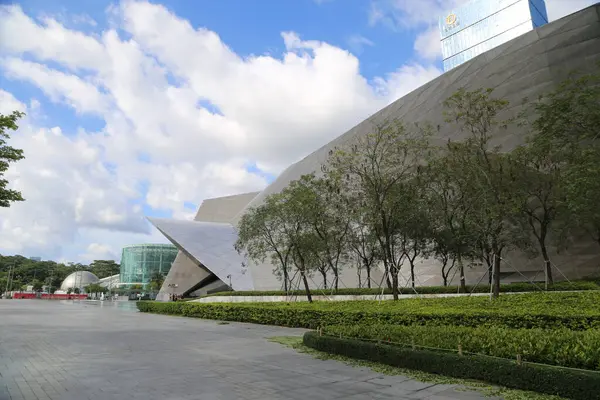
Hainan Science Museum in China features a spiraling ramp resembling a twisting DNA strand that doubles as exhibition space across five stories.
Opening in 2025, the 500,000-square-foot facility includes a planetarium and giant-screen theater alongside galleries dedicated to marine ecosystems, aerospace technology, and life sciences.
MAD Architects constructed the building from fiber-reinforced plastic, shaping it to resemble a current of air that balloons as it rises.
The structure itself becomes an exhibit about scientific principles.
Virtual reality resurrects history

Chengdu Museum in China lets visitors wear VR headsets to interact with digital reconstructions of historical scenes.
Static exhibits suddenly become living moments.
This approach proves particularly powerful for ancient civilizations where written records are sparse, yet archaeological evidence is rich.
Guests can walk through reconstructed streets, enter buildings long since crumbled, and observe daily life as it might have unfolded centuries ago in ways that traditional displays simply cannot convey.
Abu Dhabi traces cosmic origins

Natural History Museum Abu Dhabi takes visitors on a 13.8-billion-year journey from the Big Bang to the present day when it opens in 2025.
Designed by Mecanoo, the museum houses Stan, one of the most complete T. rex skeletons ever discovered, alongside specimens that tell the story of life, the universe, and everything in between.
The Saadiyat Cultural District location positions it near the Louvre Abu Dhabi.
Together they’re creating a cultural destination that rivals traditional European museum districts.
UAE celebrates founding father

Zayed National Museum in Abu Dhabi will serve as the United Arab Emirates’ national museum when it opens in 2025, though it represents something more profound than typical national institutions.
Foster + Partners designed the building to honor Sheikh Zayed bin Sultan Al Nahyan, the nation’s founding father, while celebrating the country’s rapid transformation from desert settlements to a global metropolis in just decades.
The museum demonstrates how emerging nations are building world-class cultural institutions to define their own narratives rather than relying on foreign museums to tell their stories.
Bengaluru honors tech pioneers

India’s Museum of Innovation & Technology in Bengaluru, opening in 2024, charts the city’s evolution into the country’s technology capital.
This public-private partnership showcases the engineers, entrepreneurs, and innovators who built India’s booming tech industry.
They’re often overlooked in global narratives that focus on Silicon Valley, even so their contributions have been monumental.
The museum recognizes that innovation isn’t confined to Western nations and that every tech hub deserves institutions celebrating its unique contributions.
New Museum improves accessibility

New York’s New Museum expansion, completed in 2025, prioritizes vertical circulation to improve accessibility throughout the building.
The expansion enhances visitor movement through the distinctive stacked-box structure designed by Tokyo-based firm SANAA, addressing a common museum problem where galleries become isolated islands requiring backtracking.
Better circulation means visitors with mobility challenges, families with strollers, and anyone who tires easily can navigate the space without frustration.
It’s a simple fix that makes an enormous difference.
Cleveland transforms visitor experience

Cleveland Museum of Natural History completed its $150 million transformation in late 2024 while remaining open throughout construction.
The 14,650-square-foot visitor hall now serves as the free-to-access heart of the museum, featuring iconic specimens like Happy the sauropod dinosaur and Lucy, the 3.2-million-year-old Australopithecus afarensis fossil.
Making the central hall free removes economic barriers that keep many families from experiencing museums.
This matters particularly in cities where admission costs add up quickly for households with multiple children.
Smithsonian reimagines flight galleries

The National Air and Space Museum in Washington, DC reopened reimagined galleries in 2025 after a monumental multi-year renovation.
The ‘Barron Hilton Pioneers of Flight‘ and ‘Boeing Milestones of Flight Hall‘ now showcase historic aircraft and spacecraft with modern storytelling techniques.
These connect achievements to broader social and technological change, whereas the old displays focused narrowly on technical specifications.The Lockheed Martin IMAX Theater’s return adds another dimension, letting visitors experience flight through immersive film rather than static observation.
New Jersey digs into fossils

New Jersey’s Edelman Fossil Park & Museum opens for the first time in spring 2025 after being on expected museum lists for years.
The complex combines an operating fossil site with exhibit halls, where visitors can observe paleontologists excavating fossils in real time.
This working museum approach brings urgency and exhilaration that static institutions cannot match.
Tourists may be able to witness the uncovering of a species unknown to science and not just see fossils unearthed decades ago, thereby completely transforming the experience.
Dutch photography finds new home

Nederlands Fotomuseum, the Netherlands’ national photography museum, moves to Rotterdam’s historic dock area in the latter half of 2025.
The relocation positions photography as a distinct art form deserving dedicated space rather than sharing galleries with paintings and sculptures.
Still, you might wonder why this matters.
Photography’s relatively recent invention means its institutional history is being written right now, and purpose-built museums like this one help establish it as culturally significant as older media.
Los Angeles builds community hub

NHM Commons at the Natural History Museum of Los Angeles County opened in autumn 2024 as a community hub rather than just more exhibition space.
The 75,000-square-foot addition includes a plaza for community events, a 400-seat theater for performances and talks, and substantial free-access areas.
This ‘front porch’ approach acknowledges that museums serve communities beyond tourists.
Cultural institutions should function as gathering places woven into daily life rather than destinations visited once every few years, despite this being a departure from traditional models.
Madrid offers 360-degree immersion

Prado Museum in Madrid introduced its first 360-degree immersive experience in 2019, letting users explore artworks and artifacts more intimately than physical visits allow.
Digital platforms Patron 2.0, Feeel, 3intech, and Krill Audio collaborated to create experiences that use cinema techniques like creativity and emotion to translate cultural spaces into contemporary language.
Virtual experiences don’t replace physical visits but extend a museum’s reach.People who may never afford airfare to Spain still deserve access to humanity’s shared cultural heritage.
The future of museums unfolds

Museums are dropping their stuffy image as dusty warehouses in which rowdy schoolkids wander by static displays they’re forbidden to touch.
The institutions covered below demonstrate that museums can be as cutting-edge as technology firms, as socially engaged as nonprofits, and as fun as theme parks while retaining scholarly integrity.
Technology incorporation, community orientation, and accessibility are not faddish overlays but essential reimaginings of what museums can do.
Tourists now look for places that provide experiences rather than views, and these progressive museums provide just that.
They’re institutions where ancient past appears painfully pertinent, where one becomes a participant, not just a viewer, and where culture is something to be felt with all senses, not just something to witness.
More from Travel Pug

- Underrated Italian Towns That Beat the Tourist Crowds
- Las Vegas Tourist Traps to Skip
- Prettiest Towns in Every US State
- 18 passport-free countries for Americans
- Signs Your Cruise Is Not Worth The Cost
Like Travel Pug’s content? Follow us on MSN.